From a NASA wing STEP to a live proof-load solve.
We downloaded the official model-scale left wing of NASA's Common Research Model, pinned its hash, measured what the live service could actually handle, and ran a 5 kN structural concept load. The useful result is not a glossy stress plot. It is a traceable chain from upstream CAD to a bounded solve, including the warning that the stress mesh is not converged.
The source is a real research-aircraft wing
NASA publishes the Common Research Model so aeronautical researchers in industry, government, and academia can compare results on common geometry. Its original-CAD page includes the left wing as an as-built, model-scale STEP. We downloaded that exact archive. The untouched 53.8 MB STEP is retained beside the example with SHA-256 3dabf5dd...6e59c89.
The file is a genuine solid, not a triangle skin: OpenCASCADE found one volume. It is also far too detailed for a keyless live endpoint: 11,394 CAD faces and more than 28,000 curves. An aggressively coarse tetrahedralization still exceeded the acceptable response-time budget before it reached the structural solve.
The live model is an explicit derivative
We did not relabel a different wing as NASA geometry. The public live asset is a reproducible five-section NACA 0012 solid loft fitted to the measured span, root-chord, sweep, and vertical bounds of the untouched STEP. Its generator and both hashes are checked in. It has four CAD faces instead of 11,394 and meshes deterministically within the public limit.
That substitution is substantial. The live asset is a homogeneous outer-volume surrogate. It is not the exact NASA outer mold line, an internal wing box, a production drawing, a flight article, or certification evidence. It is suitable for demonstrating CAD ingestion and early manufacturing concept checks—nothing more.
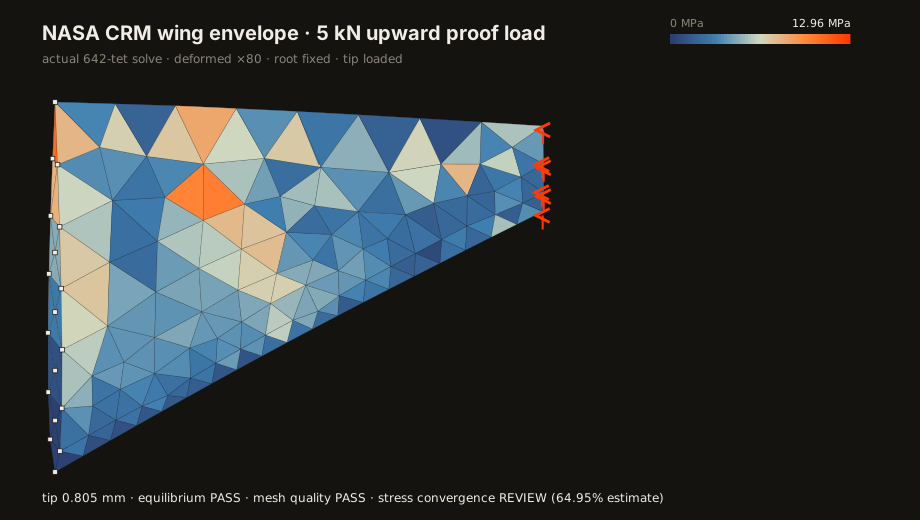
The 5 kN load case
The STEP is interpreted in millimetres and scaled to SI metres. The root plane is fixed in translation. A total upward 5 kN force is shared over the tip-face nodes. The demonstration assigns homogeneous 6061-T6 aluminum properties: E = 69 GPa, ν = 0.33, and a conservative 240 MPa comparison value. Those are illustrative inputs, not a claim about the real wind-tunnel model.
| Quantity | Result | Evidence |
|---|---|---|
| Solver mesh | 216 nodes / 642 tet4 | 0 inverted |
| Peak von Mises | 12.961 MPa | coarse-mesh value |
| Maximum displacement | 0.8045 mm | at the tip |
| Nominal material screen | 18.518 | 240 MPa / peak |
| Relative equilibrium residual | 3.19 × 10⁻¹² | PASS |
| Maximum aspect ratio | 6.65 | PASS |
| Stress-recovery error estimate | 64.95% | REVIEW |
The nominal safety factor is deliberately not a design pass. Global equilibrium and element validity pass, but the Zienkiewicz-Zhu recovery estimate says the stress field needs refinement. The endpoint therefore returns an overall REVIEW verdict. A manufacturing decision would additionally require the real internal structure, joints, load introduction, material certificates, multiple mesh levels, and validated load cases.
Run the same pipeline
GET  /demo/cad

POST /demo/cad/nasa-crm-wing
{ "load_n": 5000 }

← STEP provenance + gmsh/OpenCASCADE mesh
← displacements + element stresses + reactions
← model bundle + equilibrium + quality + REVIEW verdict
The load is bounded to 1–10 kN. The route accepts no path or uploaded geometry, and the checked-in STEP hash must match before meshing. Repeated load-slider runs reuse the immutable base mesh.